
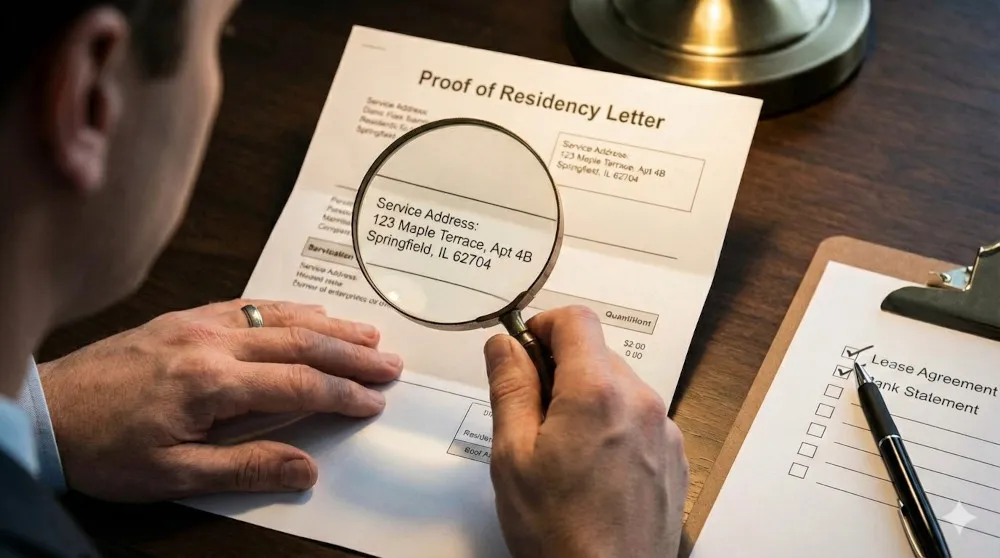
What Counts as Proof of Residency? Acceptance Rules by Office
What counts as proof of residency, what gets rejected and why, and how requirements differ at the DMV, schools, and banks.
What counts as proof of residency?
It is a test rather than a fixed list. A document counts when the specific office asking will accept it — the same bill that satisfies your bank can be turned away by the DMV. Every accepted document passes the same three tests: your name is on it, it shows your current physical residential address, and it was issued recently. Documents fail most often for predictable reasons: a PO box instead of a street address, a spouse's or parent's name, or a date that is too old. When nothing qualifying is in your own name, a signed residency letter is the standard substitute.
- Three tests, always. Your name, your current physical address, and a recent issue date. Miss one and it is refused.
- A PO box fails. Offices are confirming where you live, not where you collect mail.
- Someone else's name fails. A bill in a spouse's or parent's name does not prove your residency, even when you live there.
- Requirements differ by office. The DMV, schools and banks each weigh the same documents differently — check the specific list.
- Nothing in your name? Use a letter. A signed residency letter from your landlord or host is the accepted substitute.
“What counts” as proof of residency is not a fixed list — it is a test. A document counts when the specific office asking will accept it, and the same bill that satisfies your bank might be turned away by the DMV. This guide focuses on the acceptance side: the criteria a document has to pass, what commonly gets rejected, and how the rules differ by requester.
For the catalog of documents themselves, see proof of residency documents. Here we cover whether yours will actually be accepted.
The three tests a document has to pass
Before anything else, an accepted document must clear all three of these. Miss one and it usually counts for nothing:
- It names you. A bill in your spouse’s or roommate’s name does not prove your residency on its own.
- It shows a physical address. A PO box or a mailing-only address is routinely rejected; offices want where you actually live.
- It is recent enough. Most requesters want the last 30 to 90 days. A bill from last year is stale, even if nothing has changed.
What commonly gets rejected
Applications stall on the same avoidable problems:
- Documents that are too old — outside the office’s date window.
- A name mismatch — the document is in someone else’s name, or a maiden vs married name differs from your ID.
- Screenshots or photos without detail — a cropped image with no issuer, address, or date.
- A PO box instead of a street address.
- Informal notes — a handwritten message or a text is not a document.
- Wrong document type for that office — a phone bill where the DMV specifically wants a core utility, for example.
Format and presentation matter as much as the fact itself. A clean, complete, in-window document counts; a messy or partial one often does not.
How requirements differ by requester
The same phrase means different things at different counters:
- The DMV / REAL ID. The strictest common case: usually two documents from different sources, both recent, both showing your in-state street address. States publish their own exact lists, so check yours.
- Schools. Districts want proof the child lives inside the boundary — often a lease or utility bill plus, in many districts, a signed residency affidavit from the parent. See what districts ask for in proof of residency for school enrollment.
- Banks. Under Know-Your-Customer rules they accept a recent utility bill or statement; some accept a signed letter for address confirmation at the bank.
- Landlords and employers. More flexible, and more likely to accept a signed letter from a previous landlord or a household head.
When a letter counts as proof of residency
When you have no qualifying document in your own name, a proof of residency letter from a third party — the landlord or homeowner you live with — often counts, especially for banks, schools, and landlords. Stricter offices may want it notarized as an affidavit of residence. See who is allowed to write one in our residency letter guide.
Make sure yours counts
If your documents are shaky, a clean signed letter can be the item that gets accepted:
Generate a Proof of Residency Letter
Important notes
Acceptance rules vary by state, institution, and country, and each office sets its own. This page is informational, not legal advice. Always confirm the exact requirements with whoever requested your proof of residency.
This guide helps you avoid a rejected application.
Ready to Create Your Letter?
Generate a professional verification letter in minutes — no templates to download, no formatting headaches.