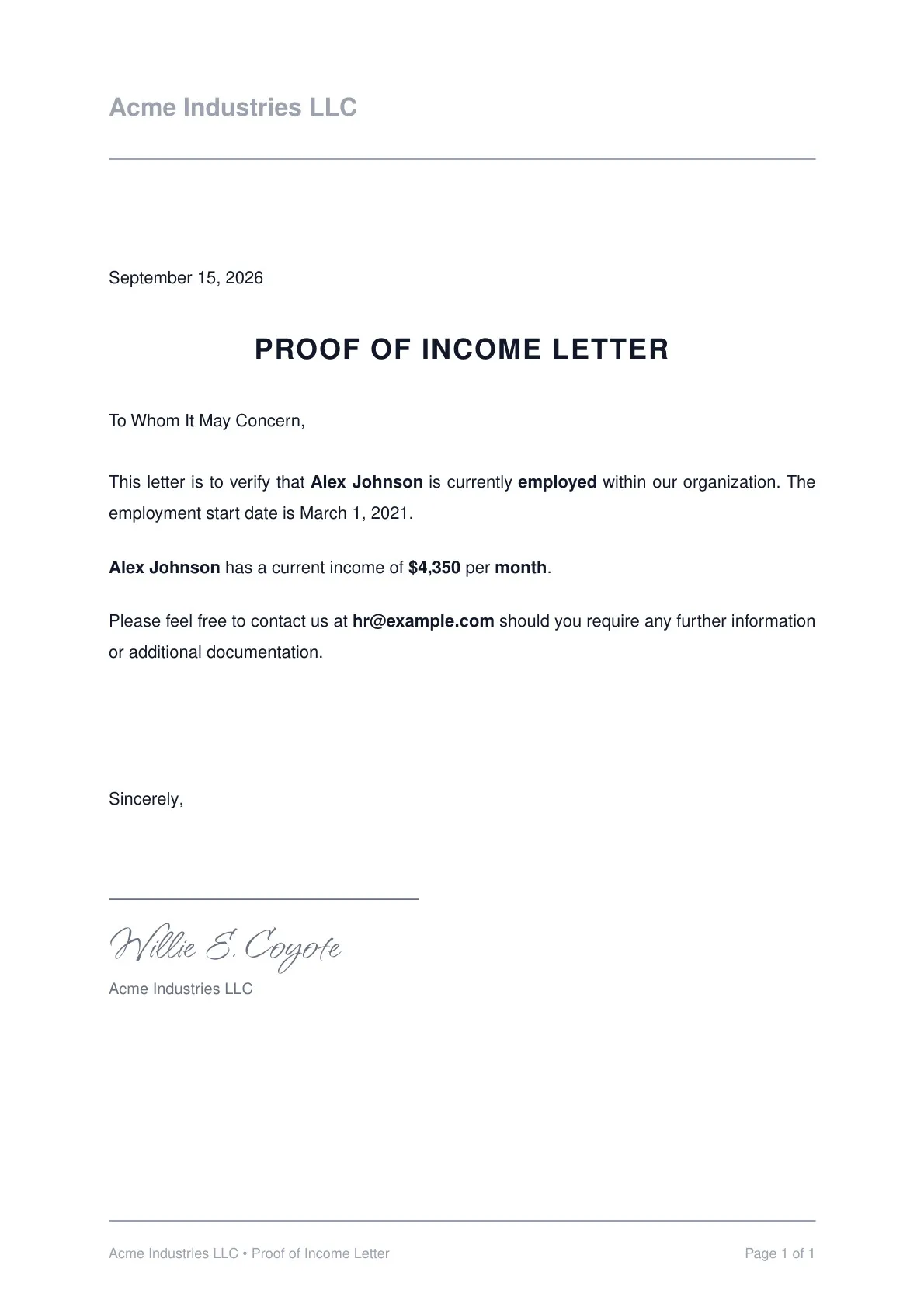
To write a proof of income letter, state the earner's full name, the income amount, how often it is paid, and for how long it has been earned. Open with the date and who will read the letter, such as a landlord or lender. Give the figure as an annual salary, a monthly amount, or an hourly rate, and name the pay type: salaried, hourly, commission, or self-employed. Close with the signer's name, title, contact detail, and signature. An employer or HR is the most trusted signer; a letter you sign alone counts for less. Keep the figures accurate — the reader may call to confirm them.
Open with basics Start with the date and who will read it: the landlord, lender, or agency. Then add the earner's full name and, where it fits, the job title.
State the income Give the figure as an annual salary, a monthly amount, or an hourly rate. Note the pay type: salaried, hourly, commission, or self-employed.
Show stability Say how long the income has been earned. That length signals stability to the reader.
Pick the signer An employer or HR signs for salaried and hourly workers. An accountant is common if you work for yourself. A letter you sign alone counts for less, so add pay stubs or bank records.
Close with proof End with the signer's name, title, contact detail, and signature. Keep the figures accurate — the recipient may call the issuer to confirm them.
Use the template This page shows a filled-in example. The linked tool makes your own version with editable wording, an instant preview, and a PDF download.
Templates built and maintained by
Dani Herrero, Product Lead at VerificationLetters.
Templates only — not legal advice; acceptance depends on the requesting
institution.
Reviewed for practical accuracy by
Dani Herrero
· 27 August 2026.
Sample proof of income letter
Below is an example of a completed proof of income letter. It includes all commonly required details:
Full name
Income source
Income amount
Income frequency
Period covered
Issuer name and address
Issue date
Reference number
Authorized signature
The wording is neutral and straightforward.
What a proof of income letter sample contains
A proof of income letter — sometimes called an income verification letter or salary
verification letter — confirms how much a person earns and how steadily. A complete
sample includes:
Date and recipient — addressed to the landlord, lender, or agency, or "To Whom It May Concern".
The earner's full name and, where relevant, job title.
The income figure stated clearly as an annual salary, a monthly amount, or an hourly rate.
Pay frequency and type — salaried, hourly, commission, or self-employed.
How long the income has been earned, which signals stability.
Who is confirming it — the employer, an accountant, or the individual — with a name, title, contact detail, and signature.
Keep the figures accurate and verifiable; a recipient may call the issuer to confirm them.
Who can write a proof of income letter
Your employer or HR department — the most widely accepted source for salaried and hourly workers.
An accountant or CPA — common for self-employed applicants and freelancers.
You, self-certified — allowed in some cases, but usually paired with pay stubs, tax returns, or bank statements, because a self-written letter carries less weight on its own.
Whoever signs it, the sample format stays the same — only the person confirming the
income changes. Landlords, banks, benefit offices, and immigration caseworkers are the
most common recipients.
When a sample is useful
A proof of income letter sample helps when you need to:
See the correct structure
Check wording before submission
Understand what information is required
Prepare a letter for an apartment, bank, or landlord